
落日歸山海,與你話清風。
1071 words
5 minutes
Fuzz two legacy CVEs in libexif

Target CVEs
Description
Compile
Download
git clone https://github.com/libexif/libexif.gitcd libexif && git checkout libexif-0_6_14-releaseBuild
这里由于我在 make 的时候有关生成文档的地方报错了,所以我手动将文档部分 patch 掉:
SUBDIRS = m4m po libexif test doc binarySUBDIRS = m4m po libexif test binaryautoreconf -fviCC=clang CXX=clang++ CFLAGS="-O0 -g -fno-inline -fno-builtin -fno-omit-frame-pointer" CXXFLAGS="$CFLAGS" ./configure --enable-shared=no --prefix="$PWD/../workshop/lib-debug/"make -j`nproc` && make installmake clean
CC=afl-clang-lto CXX=afl-clang-lto++ ./configure --enable-shared=no --prefix="$PWD/../workshop/lib-fuzz/"make -j`nproc` && make install由于 libexif 只是一个库,所以我们要 fuzz 它需要自己找个前端,或者手写 harness 。方便起见,我直接使用 exif 作为前端。
git clone https://github.com/libexif/exif.gitcd exif && git checkout exif-0_6_15-releaseautoreconf -fviCC=clang CXX=clang++ CFLAGS="-O0 -g -fno-inline -fno-builtin -fno-omit-frame-pointer" CXXFLAGS="$CFLAGS" PKG_CONFIG_PATH="$PWD/../workshop/lib-debug/lib/pkgconfig/" ./configure --enable-shared=no --prefix="$PWD/../workshop/exif-debug"make -j`nproc` && make installmake clean
CC=afl-clang-lto CXX=afl-clang-lto++ PKG_CONFIG_PATH="$PWD/../workshop/lib-fuzz/lib/pkgconfig/" ./configure --enable-shared=no --prefix="$PWD/../workshop/exif-fuzz"make -j`nproc` && make install
Samples
#!/usr/bin/env python3
import structimport os
def pack_data(fmt, endian, *args): return struct.pack(('<' if endian == 'LE' else '>') + fmt, *args)
class ExifGenerator: def __init__(self, endian='LE'): self.endian = endian self.entries = [] self.data_blobs = b''
def add_entry(self, tag, data_type, count, value): self.entries.append({'tag': tag, 'type': data_type, 'count': count, 'value': value})
def build_ifd(self, start_offset, next_ifd_offset=0): ifd_data = pack_data('H', self.endian, len(self.entries)) data_offset = start_offset + 2 + (len(self.entries) * 12) + 4
entry_bytes = b'' blob_bytes = b''
for e in self.entries: val_bytes = b'' raw_blob = None
if e['type'] == 1: # BYTE if isinstance(e['value'], int): raw_blob = pack_data('B', self.endian, e['value']) else: raw_blob = e['value'] elif e['type'] == 2: # ASCII raw_blob = e['value'].encode('ascii') + b'\x00' elif e['type'] == 3: # SHORT if e['count'] == 1: raw_blob = pack_data('H', self.endian, e['value']) else: raw_blob = pack_data('H'*e['count'], self.endian, *e['value']) elif e['type'] == 4: # LONG if e['count'] == 1: raw_blob = pack_data('I', self.endian, e['value']) else: raw_blob = pack_data('I'*e['count'], self.endian, *e['value']) elif e['type'] == 5: # RATIONAL raw_blob = pack_data('II', self.endian, e['value'][0], e['value'][1]) elif e['type'] == 7: # UNDEFINED raw_blob = e['value'] elif e['type'] == 10: # SRATIONAL raw_blob = pack_data('ii', self.endian, e['value'][0], e['value'][1])
if len(raw_blob) <= 4: val_bytes = raw_blob.ljust(4, b'\x00') else: off = data_offset + len(blob_bytes) val_bytes = pack_data('I', self.endian, off) blob_bytes += raw_blob
entry_bytes += pack_data('HHII', self.endian, e['tag'], e['type'], e['count'], struct.unpack('<I' if self.endian == 'LE' else '>I', val_bytes)[0])
return ifd_data + entry_bytes + pack_data('I', self.endian, next_ifd_offset) + blob_bytes
def create_complex_exif(endian='LE'): # 1. Build Exif SubIFD exif = ExifGenerator(endian) exif.add_entry(0x9003, 2, 20, "2026:02:24 14:00:00") exif.add_entry(0x829a, 5, 1, (1, 100)) exif.add_entry(0x829d, 5, 1, (28, 10)) exif.add_entry(0x9204, 10, 1, (-1, 3)) exif.add_entry(0x9286, 7, 8, b"USERCOM\x00") exif_sub_data = exif.build_ifd(0) # Length check only first
# 2. Build GPS IFD gps = ExifGenerator(endian) gps.add_entry(0x0000, 1, 4, b'\x02\x02\x00\x00') gps.add_entry(0x0002, 5, 3, (1, 1)) # This will actually need 3 rationals, but let's keep it simple # Fix: GPS Latitude is 3 rationals gps.entries[-1] = {'tag': 0x0002, 'type': 5, 'count': 3, 'value': (40, 1, 30, 1, 15, 1)} gps_data = gps.build_ifd(0)
# 3. Build IFD0 ifd0 = ExifGenerator(endian) ifd0.add_entry(0x010e, 2, 11, "Fuzz Test") ifd0.add_entry(0x0110, 2, 11, "Gemini Cam") ifd0.add_entry(0x8769, 4, 1, 0) # ExifOffset ifd0.add_entry(0x8825, 4, 1, 0) # GPSInfo
# IFD0 fixed size: 2 + 4*12 + 4 = 54. Blobs: 11 + 11 = 22. Total = 76. ifd0_total_len = 76 exif_offset = 8 + ifd0_total_len gps_offset = exif_offset + len(exif_sub_data)
for e in ifd0.entries: if e['tag'] == 0x8769: e['value'] = exif_offset if e['tag'] == 0x8825: e['value'] = gps_offset
final_ifd0 = ifd0.build_ifd(8) final_exif = exif.build_ifd(exif_offset) final_gps = gps.build_ifd(gps_offset)
header = b'II\x2a\x00\x08\x00\x00\x00' if endian == 'LE' else b'MM\x00\x2a\x00\x00\x00\x08' return header + final_ifd0 + final_exif + final_gps
def save_corpus(name, data, add_exif_header=False): os.makedirs('corpus/exif', exist_ok=True) with open(os.path.join('corpus/exif', name), 'wb') as f: if add_exif_header: f.write(b'Exif\x00\x00') f.write(data) print(f"Created {name}")
if __name__ == "__main__": save_corpus('rich_le.exif', create_complex_exif('LE'), True) save_corpus('rich_be.exif', create_complex_exif('BE'), True)
SOI, APP1 = b'\xff\xd8', b'\xff\xe1' exif_payload = b'Exif\x00\x00' + create_complex_exif('LE') app1_data = APP1 + struct.pack('>H', len(exif_payload) + 2) + exif_payload save_corpus('rich_jpeg.jpg', SOI + app1_data + b'\xff\xd9') save_corpus('raw_tiff.exif', create_complex_exif('LE'), False)Fuzzing
AFLplusplus go work: afl-fuzz -i - -o out/ -s 1337 -- ./exif-fuzz/bin/exif @@.
这个 Gemini Cam 还挺滑稽的哈哈哈:
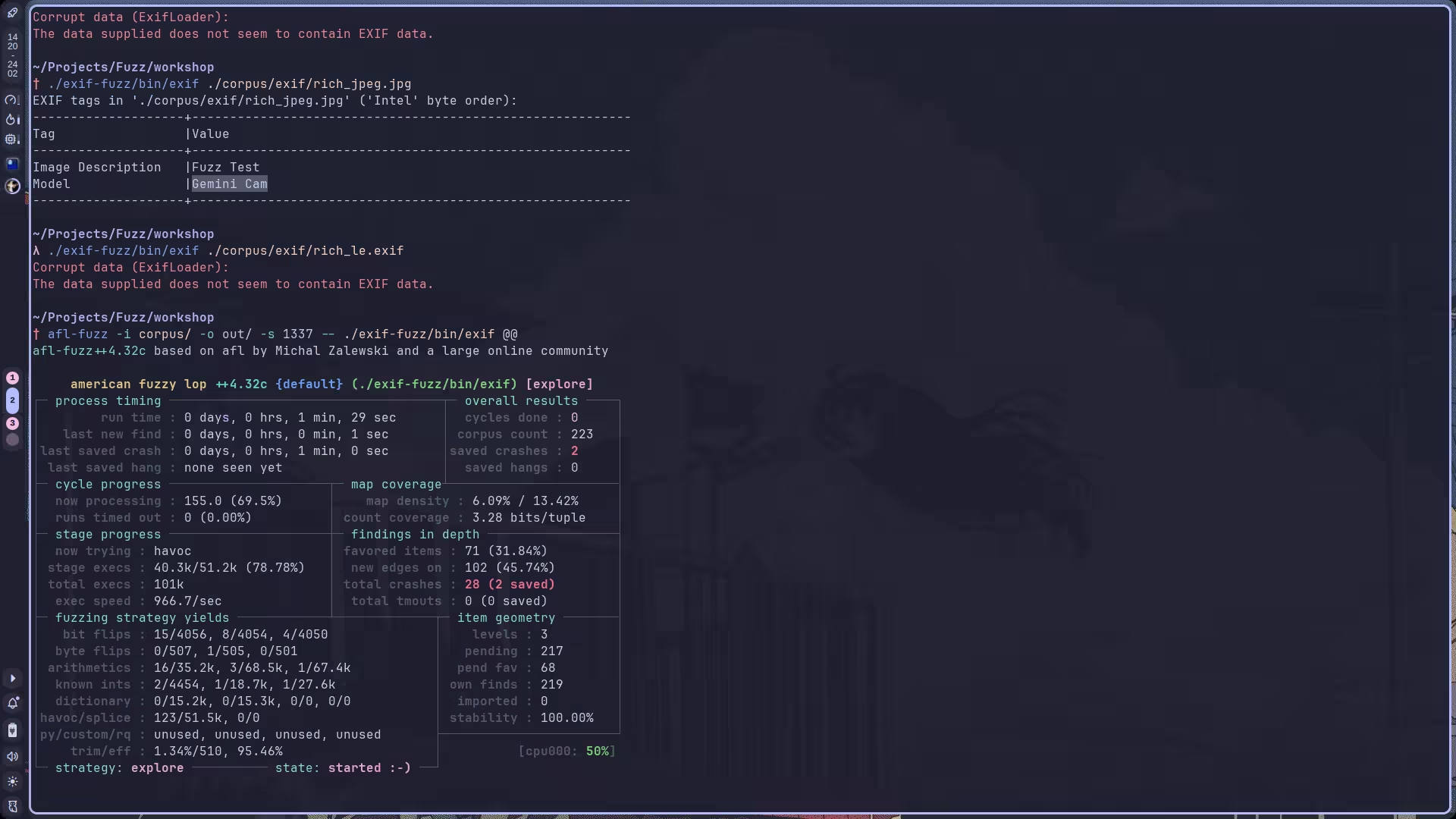
13 个 crashes,4 个 hangs,其中有这几种独立的 crash 情况:
Program received signal SIGSEGV, Segmentation fault.0x00007ffff7e595c1 in memcpy () from /usr/lib64/libc.so.6#0  0x00007ffff7e595c1 in memcpy () from /usr/lib64/libc.so.6#1  0x0000555555565553 in exif_data_load_data_thumbnail (data=0x5555555931e0, d=0x555555595986 "II*", ds=256, offset=4294967168, size=232) at exif-data.c:292#2  0x0000555555563d05 in exif_data_load_data_content (data=0x5555555931e0, ifd=EXIF_IFD_EXIF, d=0x555555595986 "II*", ds=256, offset=86, recursion_depth=1) at exif-data.c:381#3  0x0000555555563b36 in exif_data_load_data_content (data=0x5555555931e0, ifd=EXIF_IFD_0, d=0x555555595986 "II*", ds=256, offset=10, recursion_depth=0) at exif-data.c:361#4  0x0000555555563621 in exif_data_load_data (data=0x5555555931e0, d_orig=0x555555595980 "Exif", ds_orig=262) at exif-data.c:813#5  0x000055555556cb9b in exif_loader_get_data (loader=0x555555593190) at exif-loader.c:387#6  0x000055555555f73e in main (argc=2, argv=0x7fffffffdca8) at main.c:438
Program received signal SIGSEGV, Segmentation fault.0x000055555556e5bf in exif_get_slong (b=0x5555555b2000 <error: Cannot access memory at address 0x5555555b2000>, order=EXIF_BYTE_ORDER_INTEL) at exif-utils.c:137137                     return ((b[3] << 24) | (b[2] << 16) | (b[1] << 8) | b[0]);#0  0x000055555556e5bf in exif_get_slong (b=0x5555555b2000 <error: Cannot access memory at address 0x5555555b2000>, order=EXIF_BYTE_ORDER_INTEL) at exif-utils.c:137#1  0x000055555556e44f in exif_get_long (buf=0x5555555b2000 <error: Cannot access memory at address 0x5555555b2000>, order=EXIF_BYTE_ORDER_INTEL) at exif-utils.c:167#2  0x0000555555565fd6 in exif_entry_fix (e=0x555555593460) at exif-entry.c:193#3  0x0000555555562d4d in fix_func (e=0x555555593460, data=0x0) at exif-content.c:231#4  0x00005555555629f3 in exif_content_foreach_entry (content=0x555555593270, func=0x555555562d30 <fix_func>, data=0x0) at exif-content.c:200#5  0x0000555555562bbc in exif_content_fix (c=0x555555593270) at exif-content.c:247#6  0x0000555555565431 in fix_func (c=0x555555593270, data=0x0) at exif-data.c:1169#7  0x000055555556507a in exif_data_foreach_content (data=0x5555555931e0, func=0x555555565390 <fix_func>, user_data=0x0) at exif-data.c:1031#8  0x0000555555564384 in exif_data_fix (d=0x5555555931e0) at exif-data.c:1176#9  0x0000555555563866 in exif_data_load_data (data=0x5555555931e0, d_orig=0x555555595980 "", ds_orig=82) at exif-data.c:871#10 0x000055555556cb9b in exif_loader_get_data (loader=0x555555593190) at exif-loader.c:387#11 0x000055555555f73e in main (argc=2, argv=0x7fffffffdca8) at main.c:438
Program received signal SIGSEGV, Segmentation fault.0x000055555556e382 in exif_get_sshort (buf=0x555655595985 <error: Cannot access memory at address 0x555655595985>, order=EXIF_BYTE_ORDER_INTEL) at exif-utils.c:9494                      return ((buf[1] << 8) | buf[0]);#0  0x000055555556e382 in exif_get_sshort (buf=0x555655595985 <error: Cannot access memory at address 0x555655595985>, order=EXIF_BYTE_ORDER_INTEL) at exif-utils.c:94#1  0x000055555556e2ef in exif_get_short (buf=0x555655595985 <error: Cannot access memory at address 0x555655595985>, order=EXIF_BYTE_ORDER_INTEL) at exif-utils.c:104#2  0x0000555555563651 in exif_data_load_data (data=0x5555555931e0, d_orig=0x555555595980 "Exif", ds_orig=61) at exif-data.c:819#3  0x000055555556cb9b in exif_loader_get_data (loader=0x555555593190) at exif-loader.c:387#4  0x000055555555f73e in main (argc=2, argv=0x7fffffffdca8) at main.c:438
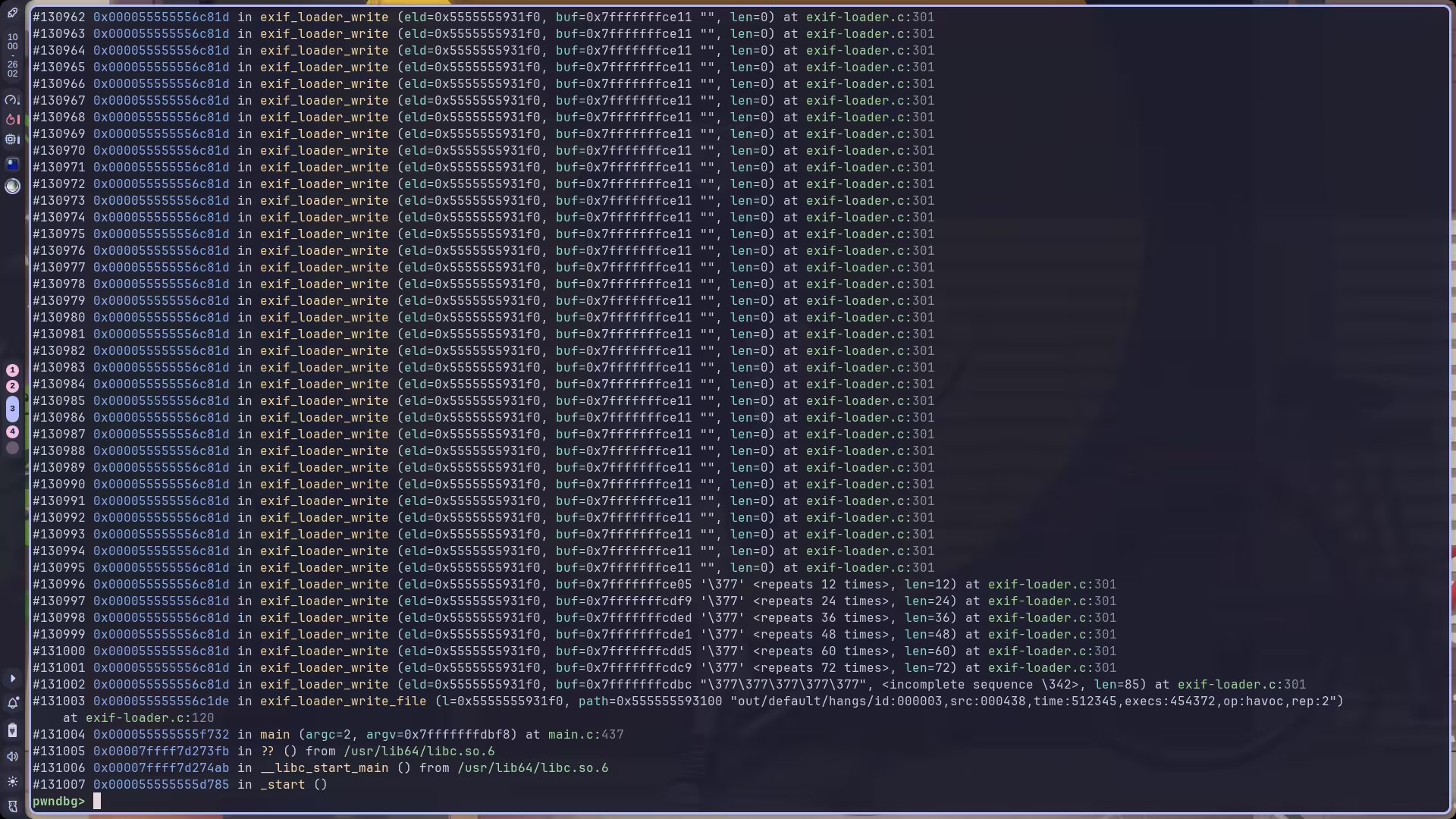
hand 的情况比较唯一,全是卡在 exif_loader_write 这里:
Analysis
这个项目有 API 文档,不用自己猜函数功能了:libexif Project Documentation.
好的,继续玩 MC,快开学了,谁学啊!?
Fuzz two legacy CVEs in libexif
https://cubeyond.net/posts/fuzz/libexif/